Start with the result. This is a fight on a campaign map as the game looks now, recorded from the game itself.
And this is the same opening view of the fifth mission, three days apart. Nothing about the map changed. The tiles, the buildings, the units and the frame around them did.
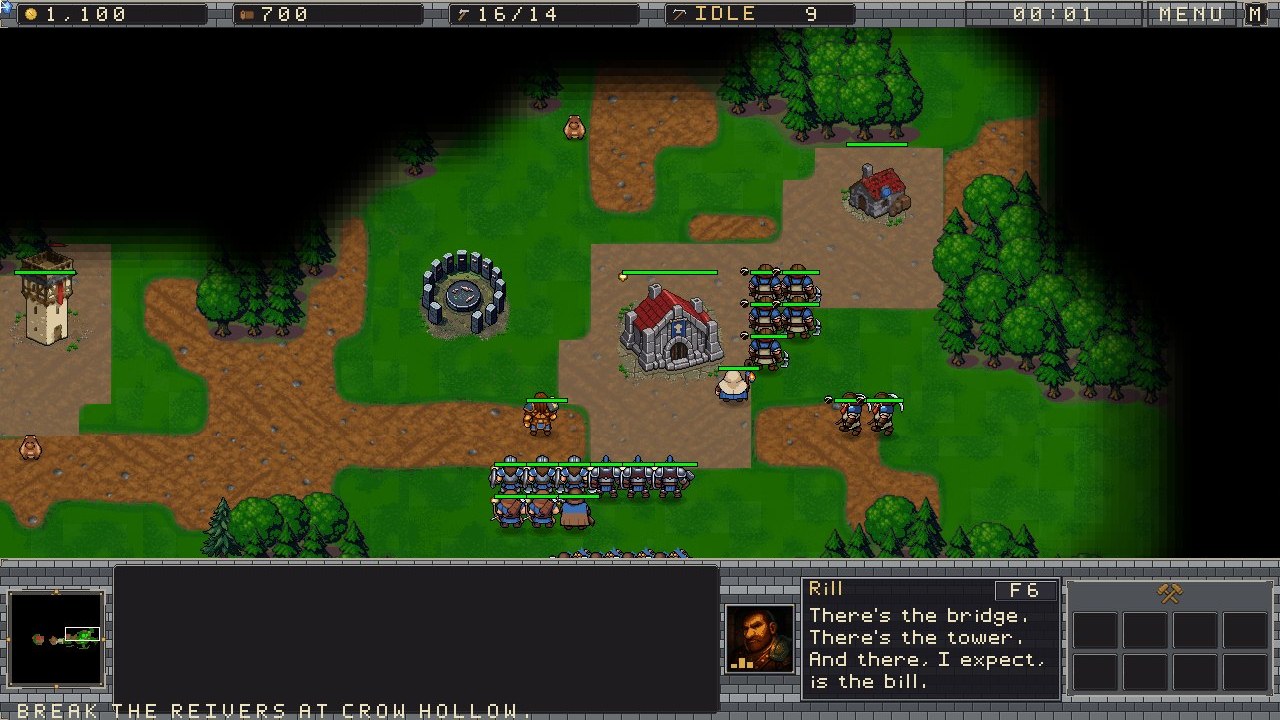
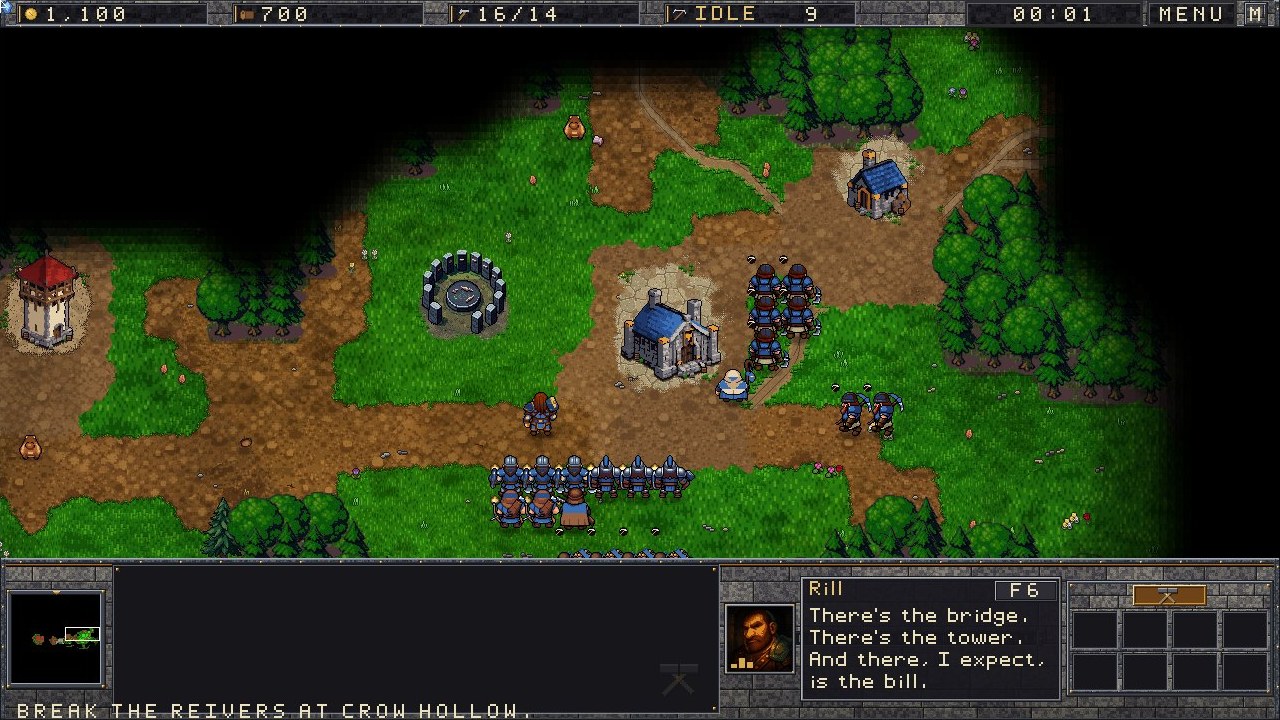
A review first
The round began with a written review, not with drawing. The orchestrating AI session took fresh screenshots of seven missions and set them next to the reference screenshots the game's maker has given it from the start: the classic 1990s strategy games this project is modelled on. It scored each area and named the main gap.
- Rock and forest were close.
- Grass and dirt showed their grid, and the dirt repeated.
- The dwarves were close. The other races each looked drawn by a different hand, because they were made in different weeks.
- Buildings were too small beside the units, and their roofs fought with the player's colour.
- Hit effects were the right style and nearly invisible at play size.
- The interface was furthest off. It read as a debug overlay.
Fifty-nine directions, then twenty more
Six agents then explored, one area each: interface, terrain, characters, buildings, effects and atmosphere. They were told not to change the game. Each returned a board of options, fifty-nine in all, from light touch-ups to full remakes.
The maker went through the boards on a review page and left comments on the cards. The buildings got the most attention, so a second round produced twenty building styles in five families. His answers set the brief for everything after:
- Buildings in an inked, faceted style with chunky hand-placed pixels. The painted family was turned down as too realistic.
- Every roof carries the player's colour. In a match with friends, that is how you tell whose town you are looking at.
- Buildings drawn larger on the same footprint, so nothing about placement or pathing changes.
- Ground with painted texture under the tiles, not a tidier grid.
- Hits made slightly bigger. Spells with real presence.
- The interface rebuilt in stone, with a frame for each faction.
Five lanes at once
Production ran as five lanes in parallel, each a developer agent with its own copy of the project and its own brief.
Buildings. Fifty-three sets of building art, covering every race: the standing building, its construction stages, its rubble and its icon. Sprites are up to one and a half times taller than before and at most an eighth wider, on unchanged footprints. Each one stands on a ragged base that meshes with the ground, which is something the maker has asked for more than once.
Ground. Seventeen of the eighteen campaign maps and four versus maps were repainted through the game's own map bake. Passability, wood and every gameplay flag were compared tile by tile and are identical. The second mission was left out, because it still uses an older terrain format that ties harvesting to specific tiles.
Units. One finishing pass went over eighty-eight sprite sheets so the races sit together: the same outline weight, the same shading range. Three of the weakest units were remade outright, the High Elf Archer, the Trogg Brawler and the Human Peasant. Then team colour was measured on every sheet and raised until each fighting unit shows about a fifth of its visible pixels in the player's colour.
Interface. Stone, iron and brass, with a frame that changes with the faction you play. Health bars now sit above each unit and building, never across its middle. Their position is worked out from the art itself, for 214 kinds of unit and building, so a taller tower gets a higher bar without anyone typing a number.
Effects. Ten hit effects were recut about a third larger. The spells got a wind-up, an impact and an aftermath, and trails were added to twenty-nine kinds of projectile.
What came back
The first results went on the review page as captures from the running game, and the comments came back the same day. Four of them shaped the second and third passes.
The bases were too subtle. The new buildings looked painted onto the terrain. Every base was widened, given a contact shadow, and centred on its footprint to within two pixels, with a test that fails if one drifts.
Roads ran under cliffs. The new worn trails were drawn as curves between points of interest, and some crossed rock and forest. They are now routed over walkable ground only, and a map bake fails if a single trail pixel lies on a tile a unit cannot stand on.
The spell effects were drawn circles. They were: rings and discs generated by code. They were replaced with drawn art. One plain white disc survived that pass, and it turned out not to belong to a spell at all. A guard in the test scene was hitting a workshop, and the stone-chip effect for hitting a building opened on a flat white frame.
Health bars sat on the wrong dwarf. In a packed fight a bar could land on the unit behind. The bars were narrowed and given a pale rim so each one reads as belonging to its owner. They still overlap neighbours in a crowd. Fixing that fully means changing the order the engine draws things in, and that was left alone.
Two things went wrong on the way and are worth recording.
Midway through the second pass, every session crashed at once. Each lane was restarted from its last commit. One of them found that the crashed session had resized three buildings without updating the sizes the engine expects, and that the game would not start from that branch at all. It fixed that before doing anything else.
And one effect changed the game by accident. The new art for the sapper's mine was a different size from the old, and that delayed the mine's detonation and halved its damage. The agent caught it by comparing a recorded fight before and after, cycle by cycle, and redid the art at the original size. The rule for this round was that nothing about how the game plays may change, and that comparison is how it was held.
One branch
The five lanes were then merged onto one branch and tested together. Three files conflicted. The older tools that build the Human, High Elf and Trogg buildings had to be taught to leave the remade ones alone, because they were quietly writing the old art back.
On that branch, as reported by the agent that built it:
- 1,323 content tests, 247 interface tests and 492 campaign tests pass.
- All eighteen campaign maps and the versus maps pass their map checks.
- A save taken on the new build loads again in the three missions tried.
- Four versus checks fail by design. They guard the campaign's building records against change, and this round changed them on purpose. They pass once this branch becomes the main line.
What is not done
This work is on its own branch. It has not been merged into the main line of the game, and nobody has played it yet; everything shown here is from scripted runs.
- The three remade units are not yet wired into the full death-and-remains sequence the other units have.
- Two races, the Dark Iron and the Elementals, keep their dark ash and basalt bases, and that may or may not stay.
- A few buildings on two campaign maps now touch their neighbours and need moving a tile.
- Fog of war, lighting and weather were explored and not started.
- Only about half of the remade buildings have been looked at closely in the combined build.
- Pale squares of ground show around some towers once fighting starts near them. That one was found while filming for this chapter.
Next comes the part no agent can do: sitting down and playing it.