Is this art?
A scroll along, thinking out loud about
what art means now that a machine can make it.
How this was made
Every technique below was actually used to make this essay and the site it lives on, ranging from fully by hand to fully by machine. The ✦ spark marks where AI was involved. Hover or tap any mark to read it.
✦ = AI was involved · hover or tap a mark for what it is
There's this conversation happening around whether or not using AI to create art is legitimate.
The question to document is: what is art? Why might somebody think that using AI disqualifies the artifacts produced as art, or perhaps doesn't?
I think that is, broadly, the question we're grappling with.
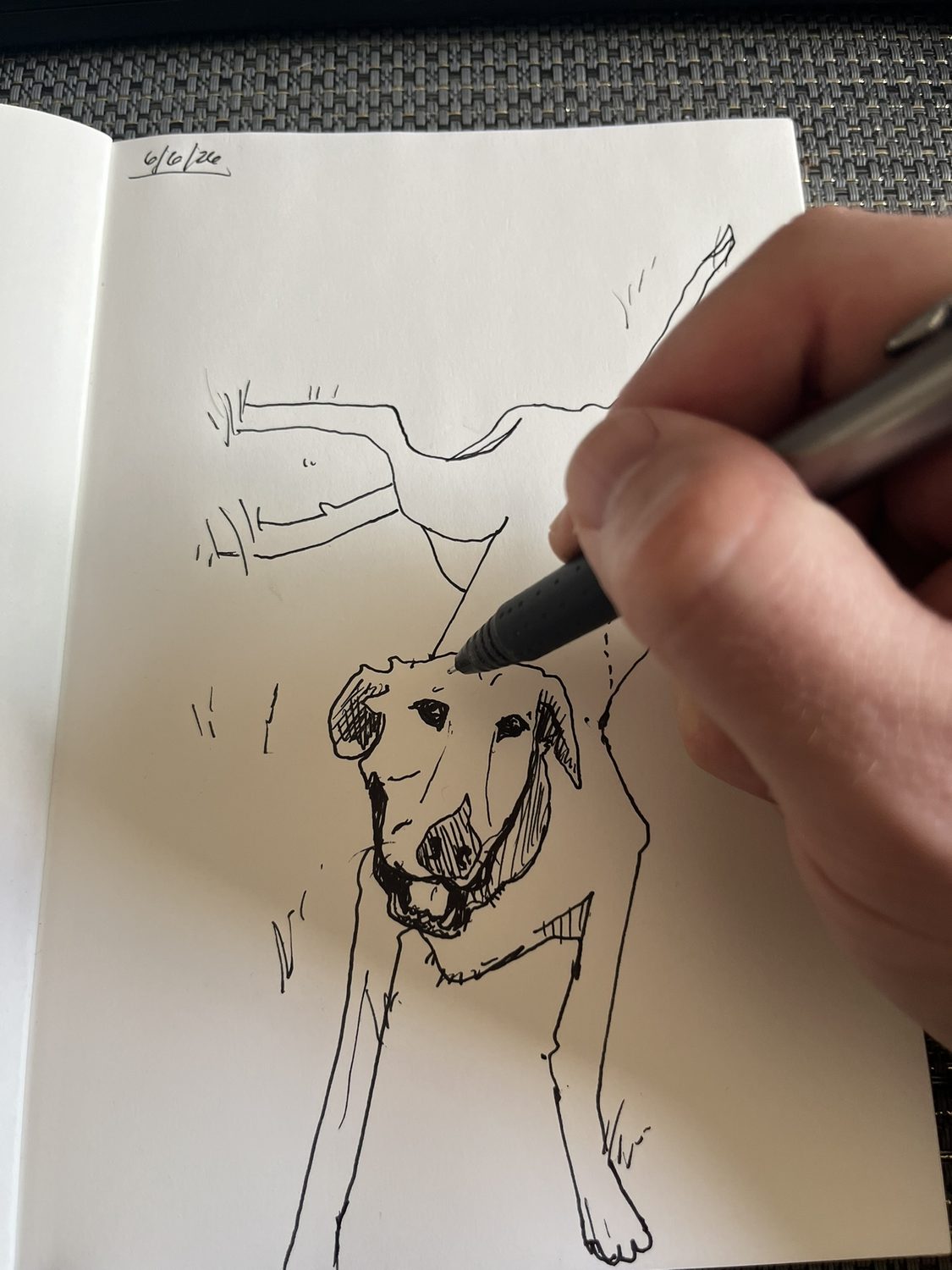
This is a drawing I made of my dog. I did that drawing this morning. I love drawing my dog. It makes me think about my dog, connects me to my dog.
Although interestingly, because my dog wasn't around this morning, I drew this from a photo reference. There's already a stabilizing effect that a technology is providing for me, where I took a picture of my dog.
This is one of the first pictures I took of my dog, actually like ten years ago. Today I pulled that up on my phone, I looked at it, and I drew my dog how it looked in that picture.
Already a digital tool is allowing me to do something that I couldn't have done otherwise. I would have had to have done it from memory.
What does my dog look like from memory? I don't think I could have done that very successfully. That is not how I practice drawing, that is not how I practice art.
Anyway, here's a first example of something that might be considered art.
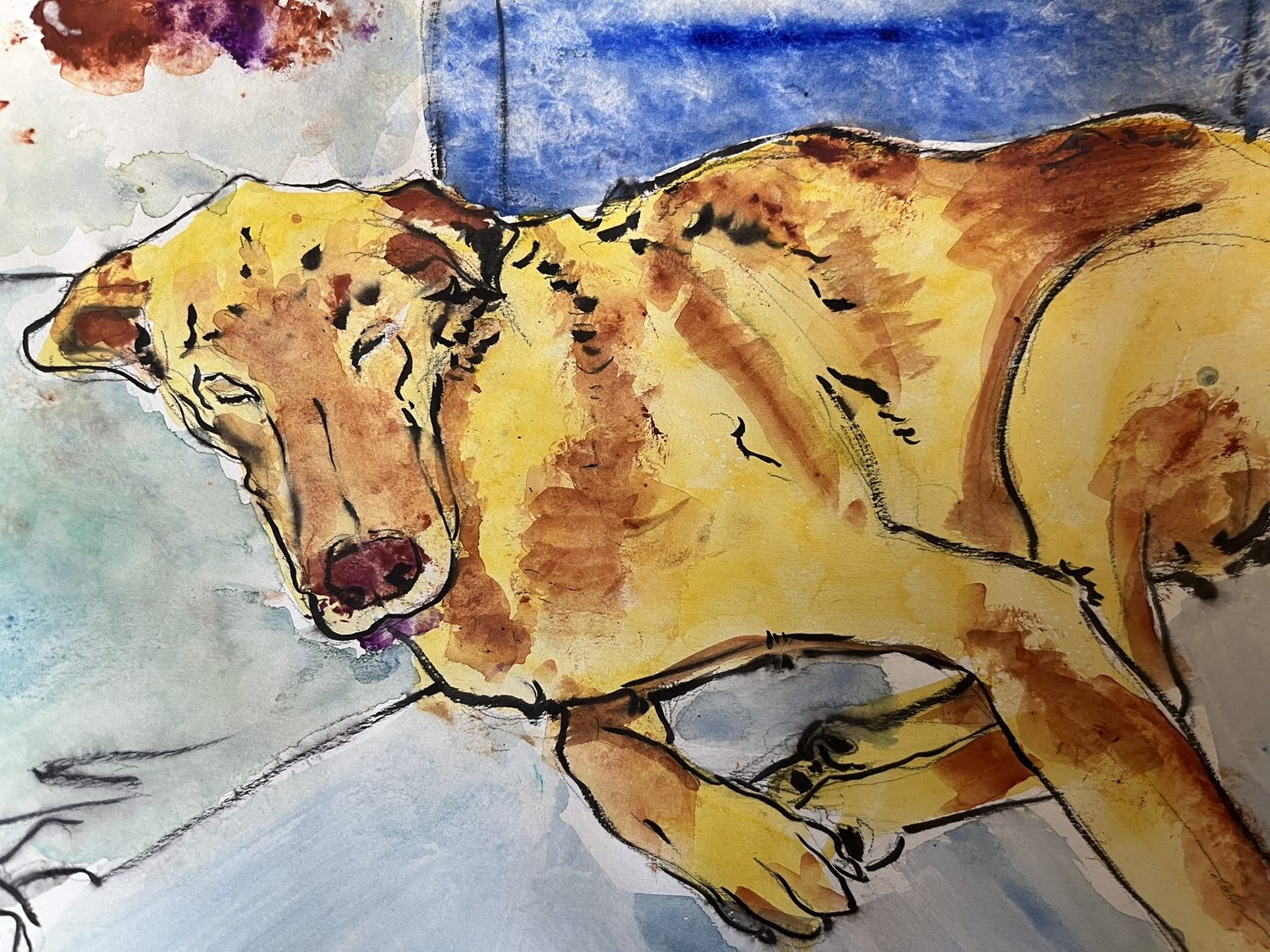
Here's another image of my dog. This is a painting I did, and it's one I really like. Again, I really like drawing and painting pictures of my dog, Goose.
There's a lot to consider here. I think, broadly, whether or not any of this so far is art. Is that sketch of my dog art? Is this image, this painting of my dog, art? What's the qualifying criteria?
Anyway, let's describe what they are. The image is something I drew by hand, looking at a photo of my dog. This painting is a painting I made with ink, pencil, and watercolor, again with a photo image of my dog.
They were both things I did. They took different amounts of time. The sketch was like 5 minutes; this painting was probably 40 minutes, and I liked doing both of them.
I did them both for myself. I don't make images and sell them, so I'm not selling my artifacts. This is just a practice I have, and I keep a lot of them in my house, and sometimes I look at them.
These are just some descriptive qualities of what's going on.
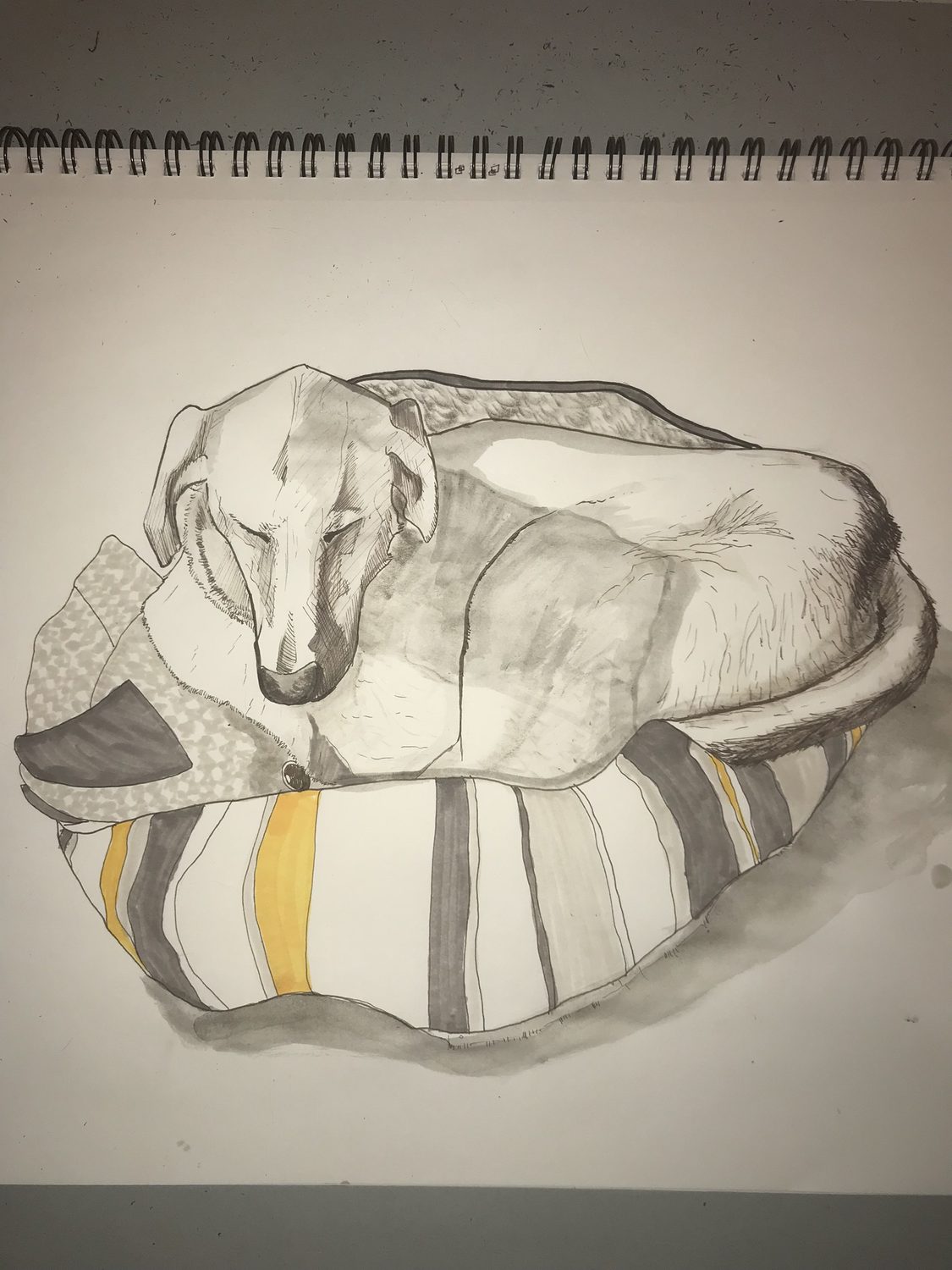
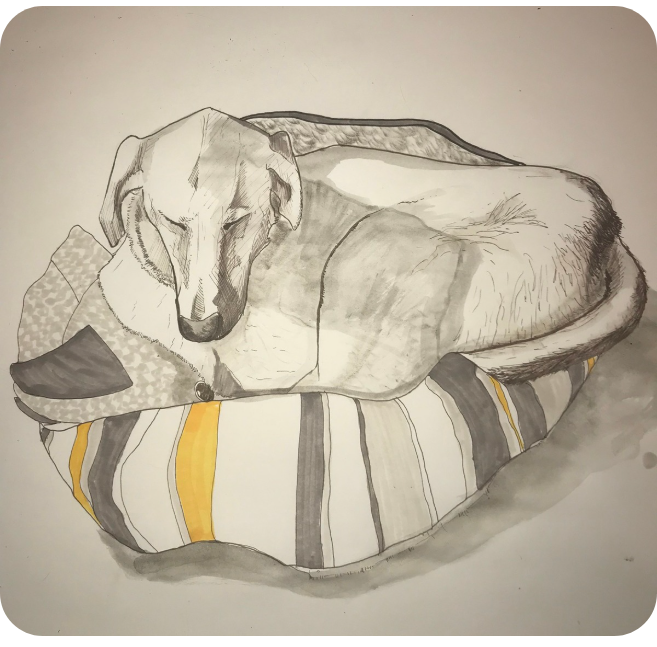
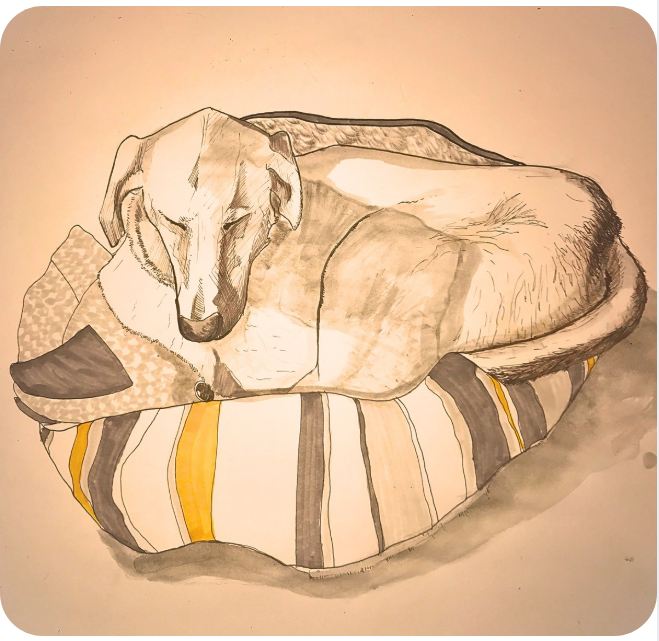
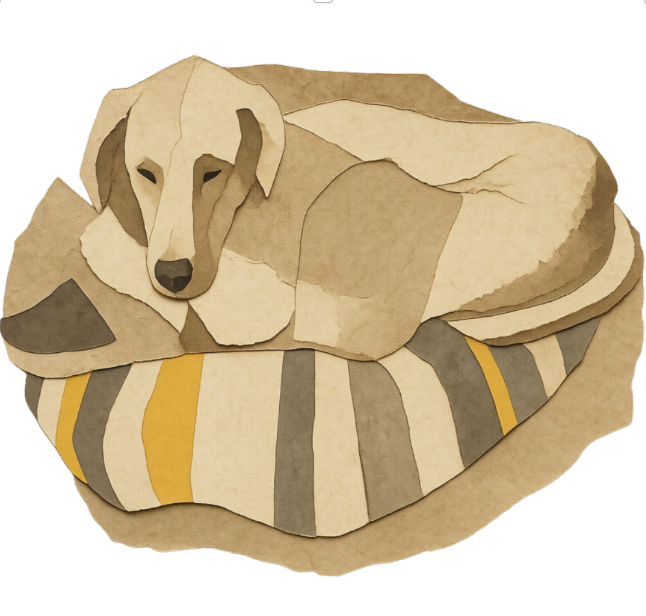
Here is a progression of using a digital tool to manipulate an image that I drew by hand to change how it looks. What does that descriptively work or look like?
I uploaded an image, drew an image, took a picture, uploaded it to Canva. Now Canva has given me this UI to interact with to do lots of different transformations of that image. Mostly what I'm doing is moving buttons around on a UI set of toggles and hitting options, and then the software is manipulating the image accordingly.
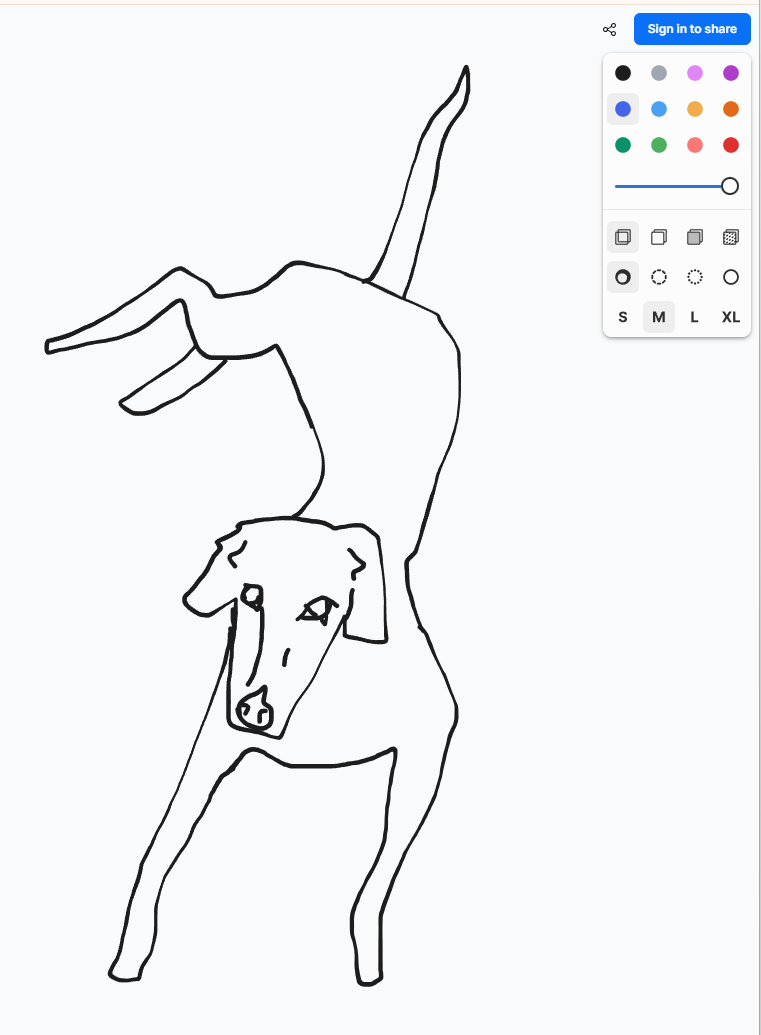
This is a quick drawing I did. I think the point to make is that when you're using a digital drawing tool, it's already making decisions for you in a lot of ways.
You can set some of the parameters going into the drawing:
- You can pick a color.
- You can adjust the line weight.
- Create a textured background.
As you are moving your mouse around the screen, the software is interpreting that movement, rendering pixels in a way that is co-creating an image. You're not the one creating those pixels on the screen; the program is, and you are directing the program to create those pixels.
You also get a new experience:
- You get to iterate much more quickly.
- You can hit undo.
- You can erase certain sections.
- You can come back and use different tools.
If we were in a fancier tool like Photoshop to adjust the pixels, adjust color, you could layer on different layers and masks. You really get a lot of power using this piece of software to create an image.
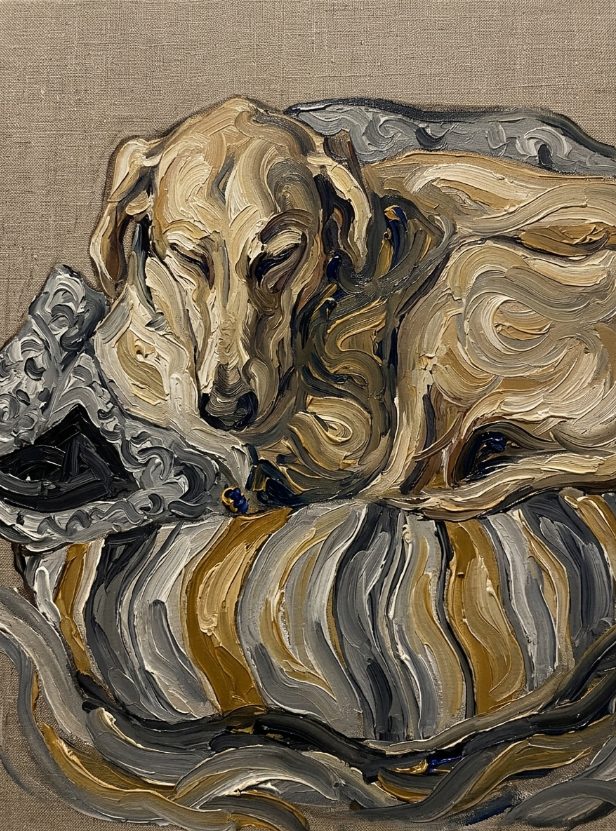
This time I went to Gemini, even more powerful of an image creation tool than photoshop, and I uploaded my image of my dog. I gave it a prompt to manipulate it in a particular way and in a particular style.
I knew certain things about impressionism and swirling and oil paint, and I had some taste. I like how that looks, so I asked it to re-render the image in that style.
Next, I didn't upload an image at all to Gemini, I just described the image and style I wanted. We went from starting with an image I drew and having Gemini manipulate it, to me just using words and getting an image output from Gemini.
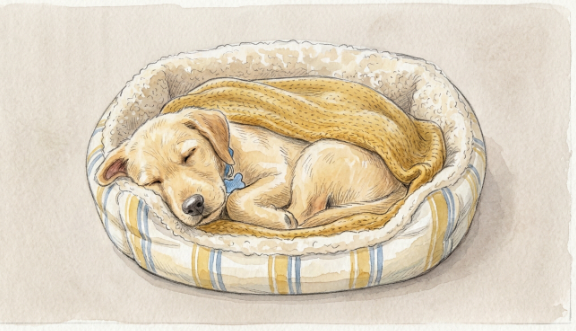
So I think the point to write down is: okay, if I'm just using words and a tool to get an image, is that art?
We've gone from:
- drawing by hand on paper very quickly
- a painting on paper by hand over 40 minutes
- taking pictures of my drawings
- uploading them into a digital tool using AI manipulation to change those images
- hitting a button and having AI change the image
- just starting with no image and just words, and having AI generate an image just from words
We have now gone from a highly embodied, skilled practice. I've been drawing my entire life. I like doing it, I use my body, and I've gotten better at it. Those initial images were the output of an embodied, skilled practice. And reached a point where my involvement is just typing words into a prompt.
The progression we went on was a progression of reducing the amount of embodied, skilled practice, as the machine did more and more and more of the rendering, to the point where it did the entire rendering.
Drag the slider to move along the progression, each step hands a little more of the rendering to the machine.
I think the thing I'm reaching here is that it's not clear to me why the involvement of my embodied skill practice makes it art or not.
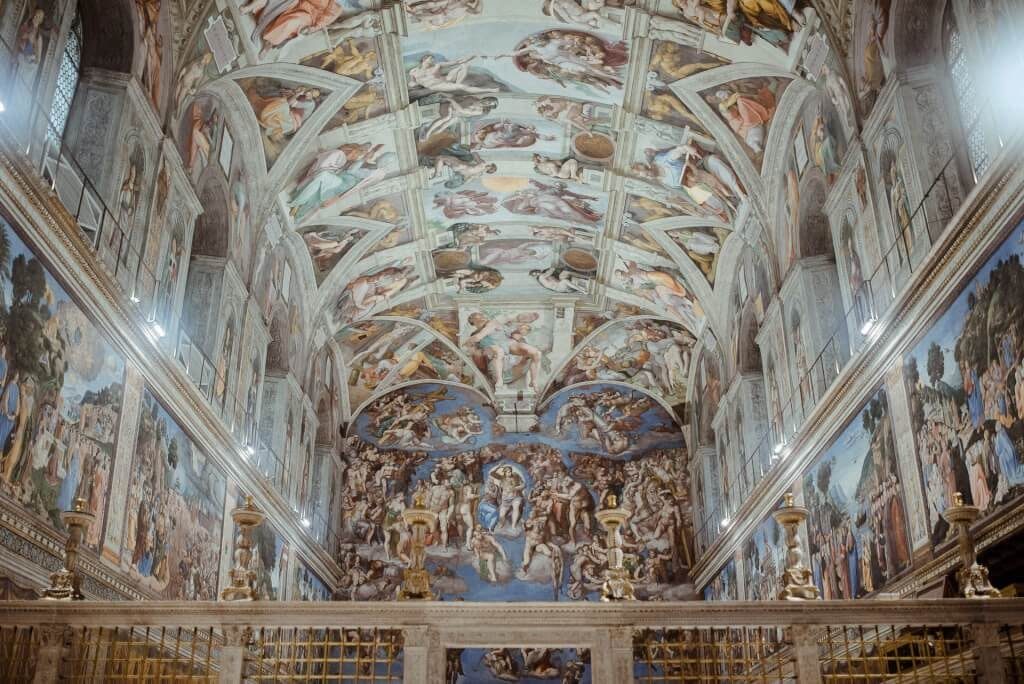
Here's another image: the Sistine Chapel. My understanding is that Michelangelo did not paint all of that himself. He ran a workshop; he had a lot of people who he apprenticed and taught, and they helped paint it. He kind of had the vision; he ran around telling people what to do with his words; it seems like he did the underdrawing, and then he had help putting all the paint on the ceiling and all that.
It's art; he is the creator of it; it's Michelangelo's Sistine Chapel. We don't know the name of any of his helpers, but while he was involved and doing his embodied skill practice, he didn't touch all of it.
Is it only the parts he touched that are art, or is it the case that, because everybody involved was exercising their embodied skill practice painting the ceiling, it's art?
There's something interesting about that: he got help; it wasn't all done by him; other people were making decisions, even if he was overseeing it to bring that thing to life.
Let's push our understanding of that further. So it's an embodied skilled practice: if you get help from other people who are exercising an embodied skilled practice, I think we say the output is still art.
What if you get help from a machine? A machine doesn't have embodied skilled practice, but a machine does reflect the intent and skill of the designer of the machine, to make that machine useful in the particular task.
Here I'm thinking about the MythBusters, who made this really cool machine that shot tons of paintballs all at once onto a canvas and rendered the Mona Lisa.
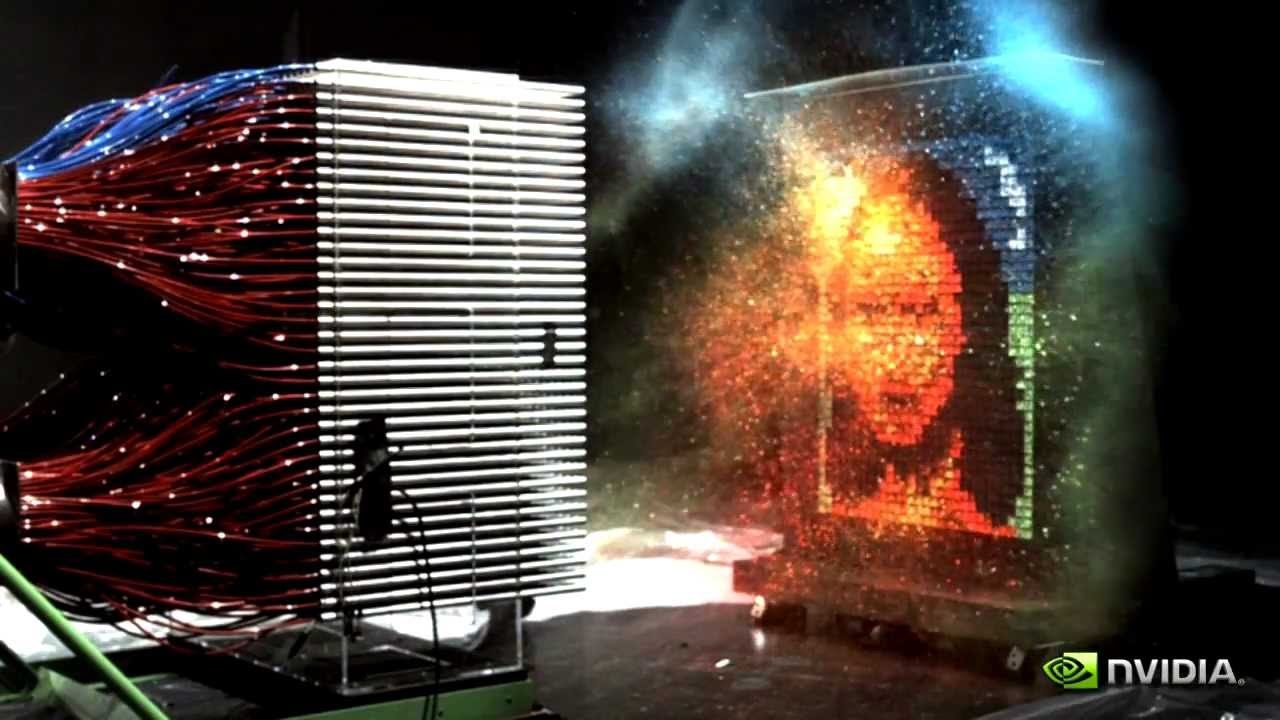
And I think what's interesting here is they built the machine, which again is kind of reflective of an embodied skilled practice. They understand engineering. They understand how to build machines. They may have had a lot of help building the machine from other people who have embodied skilled practices around building machines.
Then the machine fired. They hit a button, the machine fired, and the image rendered. It's unclear to me whether or not we'd call that image art.
Is it? They didn't exercise embodied skilled practices that we traditionally associate with art, like moving your hand and manipulating graphite on paper or whatever. These are not normal associations between art and artists and embodied skilled practice.
The engineering and mechanical building was certainly an embodied skilled practice by a human, and that practice resulted in an image output that we may consider art, that we may put on a wall, that we may put in a museum. What is different about this?
So we perhaps might consider that a machine somebody builds to create art might result in art, because a human intentionally designed a system to produce a specific output.
It might be the intent, and the work done to achieve the intent, that is what's actually reflected in the embodied skilled practice that a human has: an intent, and they are trying to achieve it.
Artists are trying to achieve it through, in most cases, practice over time, developing skills which allow them to achieve their intent with greater and greater fidelity. There are usual skills we expect, having to do with hands and drawing implements, and painting, sculpting, shaping image and space and so on.
However, you could say that somebody developing a different skill that allows them to achieve their intent, producing some artifact, is a similar effort, even if the practice looks different.
Here are two images. One is of a directory structure that I use with Claude to generate specific visual outputs for a YouTube series I run, which is about utopian visions of the future. The other is an output, which is aligned with my intent of trying to depict, in a fragmented way, positive images of the future that accompany words and voiceover.
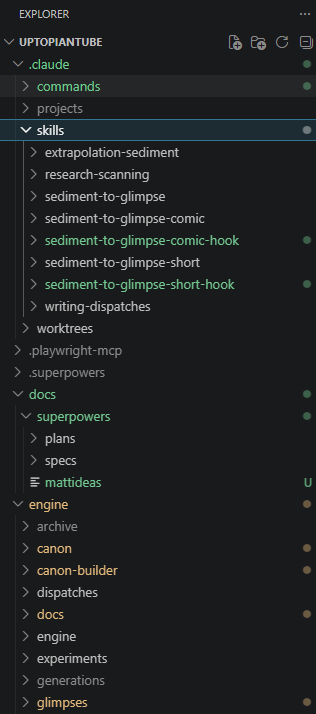
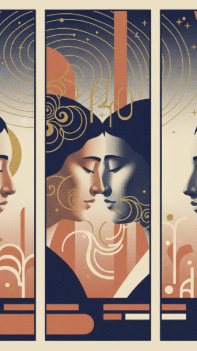
I've developed a specific pattern: references, ways of interpreting my text, researching current-state technological, political, and social advances, mapping them out into a speculative fiction of the future, and using those imaginations to create a narrative.
We've (Claude and I) also honed a visual style through conversation and documentation and iterating on prompts, to produce a specific kind of visual output that Claude and I decide together.
I've created a machine, I think, that is akin to the MythBusters machine, to then produce a visual output.
I can do this because I've gotten good at using Claude and managing Claude, to get it to produce a specific output rather than a kind of average output.
So perhaps that's what we're looking for behind art. We're looking for a skilled practice that reflects somebody being intentional about achieving a particular result or output.
If that skilled practice is absent, the intent may be absent as well, in the sense that the care for the particular output might be absent.
If the care is absent, perhaps so too is the meaning.
I think what this raises is: can art be accidental?
Harmonograph, a figure traced by damped pendulums. Click to draw another.
Strange attractor (de Jong), the same four equations, drifting forever. Click to jump it somewhere new.
It's perhaps the case that beauty can be accidental.
Like a landscape, nobody made that. Or you walk into a room, and the way it's been arranged by people coming and going creates a sense of feng shui, and it's just like: God, this place is so beautiful.
You can appreciate things that emerge accidentally, but we might not call them art, again, perhaps because the intent of a particular result isn't there.
Procedurally splattered paint, no drop placed on purpose. Click to throw another.
And is the art accidental? If I didn't make the machine that is creating the art, but I am using the machine to create art, my intent is not expressed through the design of the machine, like the MythBusters' intent was.
The machine is generating the art based on my input, where I'm trying to express an intent and, through that, a meaning and care about the output and the experience.
The experience might be iterative, and I might build in many repetitions to achieve an output. But I didn't make the machine, so is the output accidental?
If it's not accidental, because the output does reflect my intent and my care, then why isn't the output art?
So let's return to the hand-drawn image of my dog and the Gemini-generated image of my dog.
One demonstrates the result of an embodied practice. The other is an AI-generated, or machine-generated, image that captures some intent that at some point was produced by embodied skilled practice.
The ultimate output reflects the generation of a machine that was designed by other people, people who had a broader, more general intent about generative outputs.
As a way to pause here, I think it's an interesting question why somebody might recognize the first as art, but the second as not art.
And I do think a piece of the puzzle here is care. We want to know that the person who made the art cared about that art existing. If that's absent, it becomes less meaningful, or more cheap, or more throwaway.
It would be weird, for example, if I created a digital frame in my house and every morning I programmed Gemini to just throw another image into it. That could be delightful and pleasing for a while, but I think I would care a lot less about those images. They would just be a passing fancy rather than something I myself cared about.
A frame fed by the machine. Each file that arrives renders a new image. Click for another.
If you want somebody else to care about a thing, you have to care about it, too.
Perhaps what AI is stirring up is a concern that people are creating things that they don't really care about, but they want you to care about.
And I think, by way of conclusion: to me, that suggests it's not necessarily the use of AI that disqualifies something as art.
At least not from this perspective, because somebody could use AI very intentionally, and with a lot of care about the final output. Kind of like what I'm doing today, with AI, to produce this essay.
This creator could care that you care about the output, that they're trying to communicate something, or impact you in a way they think is important. They could care about you as the audience, and use AI to generate the outputs in a caring way and an intentional way.
If what we care about is that art is created with care, I don't see why using AI to create art is disqualifying.
I think that's a good place to pause. There are some other angles to investigate the nature of art in the era of AI, and I think we need a new canvas to do so.